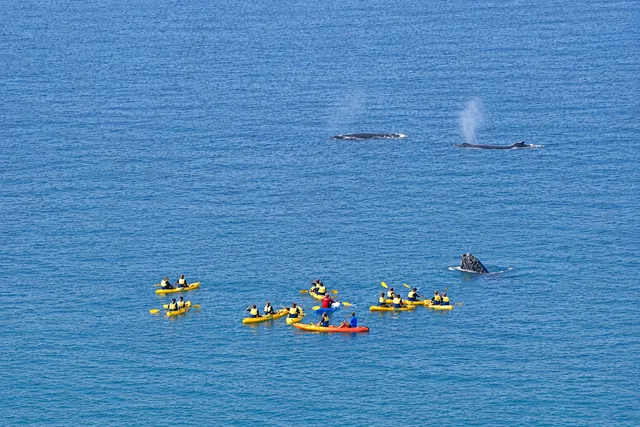
If you’ve ever been out on the water during whale season, you’ll know the feeling. Everyone goes quiet for a moment, eyes fixed on the horizon, waiting for that first sign. Then someone spots it.
“Blow!”
A few seconds later, a dark back rises from the water before disappearing beneath the surface. Sometimes you’ll catch a glimpse of a tail. And if you’re really lucky, you’ll witness a full breach that leaves everyone completely speechless.
Every winter, something pretty incredible happens off the coast of Noosa. Thousands of humpback whales make their way past Double Island Point as they migrate between Antarctica and the warmer waters of Queensland. It’s one of the longest mammal migrations on Earth, and we’re lucky enough to see it unfold right here on our doorstep.
While seeing them in the wild is unforgettable, there’s so much more to these incredible animals than most people realise.
Here are 15 humpback whale facts that might surprise you!
One of the most impressive whale facts in Australia is just how far humpback whales travel.
Every winter, more than 40,000 humpback whales migrate along Australia’s east coast, travelling over 10,000 kilometres on their round trip between Antarctica and the warm breeding waters of Queensland.
This annual journey has become so well known that our coastline has earned the nickname The Humpback Highway.
If you’re visiting Double Island Point between June and October, you’re witnessing a small part of one of nature’s greatest migrations.
This one surprises almost everyone.
You’d think an animal travelling more than 10,000 kilometres would need to stop for plenty of food along the way. But during much of their migration north, humpback whales survive almost entirely on the fat reserves they built up while feeding in Antarctica.
Throughout summer, they feast on huge amounts of krill before beginning their long journey north to breed and give birth.
It’s a pretty incredible achievement when you think about it.
We’ve heard plenty of guests say the same thing after their first whale encounter.
“I knew they’d be big… but not that big.” And they’re right.
An adult humpback whale can grow to around 16 metres long and weigh up to 40 tonnes. That’s longer than a bus and heavier than several elephants.
No matter how many photos you’ve seen, nothing quite prepares you for seeing one surface in real life.
Only male humpback whales sing, and they do so during the breeding season as they migrate north.
Their haunting songs can last for around 30 minutes and travel remarkable distances through the ocean.
Even more fascinating, each whale population develops its own version of the song, and it slowly changes over time. Scientists are still learning exactly why they sing, making it one of the ocean’s greatest mysteries.
Just like our fingerprints, every humpback whale has its own unique tail markings.
The black and white patterns underneath each tail fluke are completely different, allowing researchers to identify individual whales simply by taking photographs. Some whales have even been recognised decades after they were first recorded.
Although humpback whales are mammals, they’re incredible divers. They breathe through a single blowhole on top of their head and can stay underwater for up to 30 minutes.
Most of the time, though, you’ll see them surface every five to ten minutes while travelling. That misty blow is often the first clue a whale is nearby.
If you’ve ever seen a humpback whale launch almost its entire body out of the water, you’ve probably wondered the same thing we have.
Why would something that big jump? The honest answer is that scientists still aren’t completely sure.
Breaching may help whales communicate, remove parasites, play or interact with other whales. Whatever the reason, it’s one of the most spectacular sights you’ll ever witness in the ocean.
A newborn humpback calf measures around four to five metres long and can weigh close to a tonne.
That’s about the size of a small car before they’ve even begun their first migration.
They also grow incredibly quickly thanks to their mother’s rich milk, helping them build enough strength for the long journey back to Antarctica.
While Antarctica is perfect for feeding, it’s far too cold for newborn calves. That’s why humpback whales migrate to Queensland’s warmer waters each winter to give birth.
Later in the season, you might spot mothers heading south again with their calves swimming closely beside them. It’s one of the most special whale encounters you’ll ever witness.
The scientific name Megaptera novaeangliae roughly translates to “big-winged New Englander.”
It’s a fitting name because humpback whales have the longest pectoral fins of any whale species, with some growing close to five metres long.
Those enormous fins help them steer, balance and perform the graceful movements they’re famous for.
Humpback whales usually live between 45 and 50 years, although some have been known to live well beyond 80. That means many of the whales migrating past Double Island Point today have already completed this incredible journey dozens of times.
Not all whale facts are about size or behaviour. One of the most inspiring stories is their recovery.
Commercial whaling dramatically reduced humpback whale numbers throughout the nineteenth and twentieth centuries.
Thankfully, international protection allowed populations to recover, and today Australia’s east coast humpback population is thriving once again. It’s a powerful reminder that conservation really does work when we choose to protect our wildlife.
Whale songs might get most of the attention, but humpbacks have plenty of other ways of communicating. Tail slaps, pectoral fin slaps, breaching and other surface displays all play a role in their social lives.
Every whale encounter is a little different, and that’s part of what makes spending time around them so fascinating.
One of our favourite behaviours to watch is called…
“spy hopping”
This is when a whale slowly lifts its head straight out of the water, almost as though it’s taking a look around, before quietly slipping beneath the surface again.
No one knows exactly what they’re thinking.
Maybe they’re checking out their surroundings.
Maybe they’re just curious.
Either way, it’s one of those moments you’ll never forget.
One thing we’ve learnt after spending years on the water is that the best wildlife encounters are never the ones you try to force.
Sometimes whales stay well offshore. Sometimes they surface a little closer.
And every now and then, they’ll surprise everyone by choosing to come over and have a look for themselves.
That’s exactly how we like it.
At Epic Ocean Adventures, we never chase whales or interrupt their migration. Once we’re on the water, our kayaks are quiet, engine-free and low impact, allowing us to experience these incredible animals with as little disturbance as possible.
After all, we’re visitors in their home.
So… which humpback whale fact surprised you the most?
Was it that they travel more than 10,000 kilometres every year? That they can hold their breath for up to 30 minutes? Or maybe that scientists still don’t know exactly why they breach?
No matter how much you read about humpback whales, nothing compares to seeing them in the wild.
Every winter, Double Island Point becomes one of the Sunshine Coast’s most incredible places to witness Australia’s annual humpback whale migration. Every day on the water is different. Some days you’ll see spectacular breaches and tail slaps. Other days, it’s the quieter moments that stay with you. A mother and calf travelling side by side, or the unmistakable blow appearing on the horizon before a whale gently surfaces.
That’s the beauty of it.
Nothing is staged, nothing is guaranteed, and every encounter happens completely on the whales’ terms.
At Epic Ocean Adventures, that’s exactly how we believe whale watching tour should be.
Our kayak tours offer a quiet, eco-friendly way to experience these incredible animals. With no engine noise, no propellers and small group sizes, you’re able to connect with nature in a way that simply isn’t possible on a large boat. It’s respectful, low impact, and gives you the chance to experience one of Australia’s greatest wildlife migrations just as it should be — naturally 🙂
If you’re visiting Noosa or the Sunshine Coast during whale season, come and experience the magic of humpback whales with Epic Ocean Adventures. We can’t promise what the whales will do, but that’s exactly what makes every tour unforgettable.